

AI Crowd Management: What the Itaewon Tragedy Teaches Us About Keeping Crowds Safe
The warnings came in hours early. Nobody had the full picture in time.
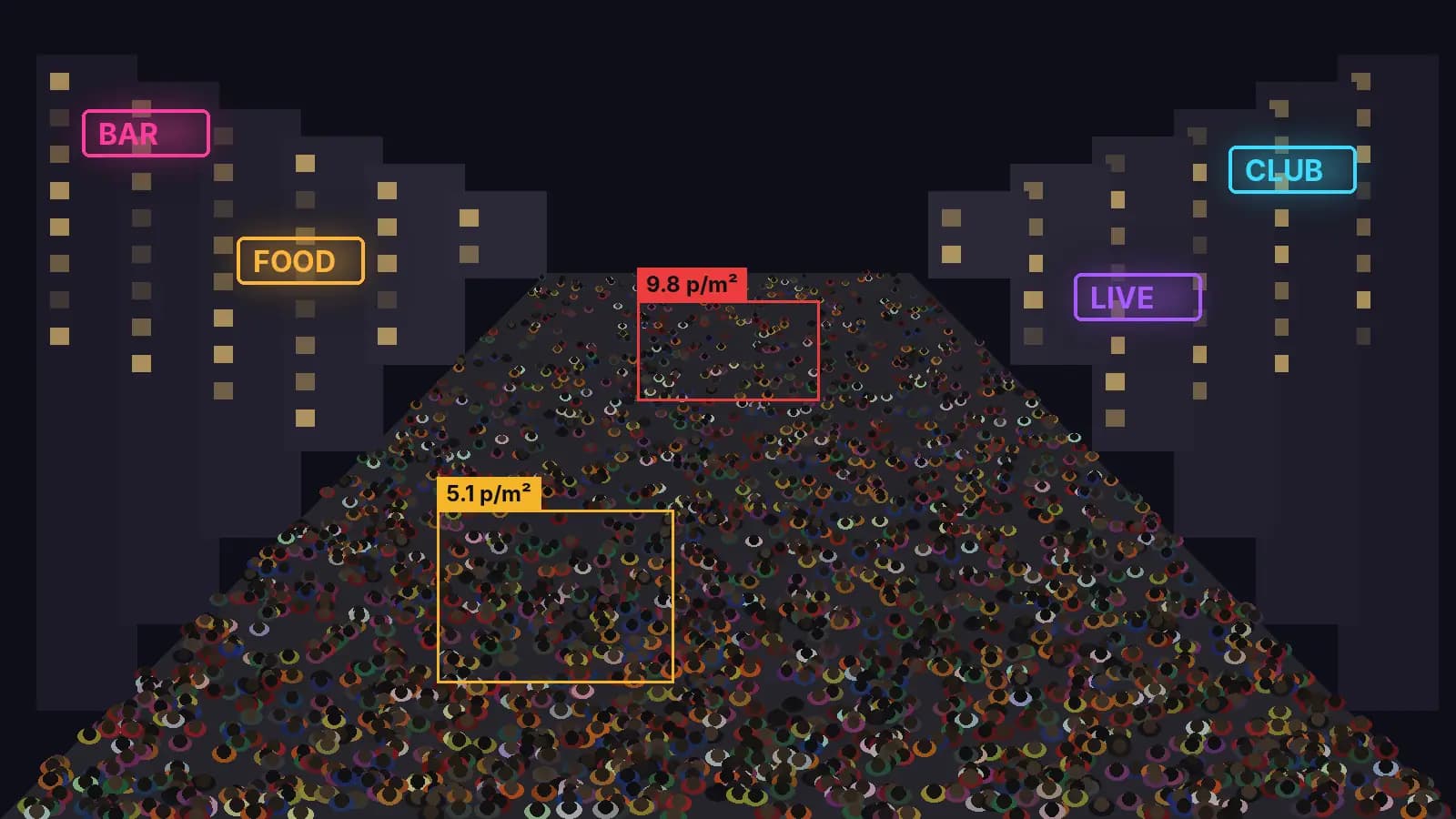
Ask anyone who has stood in a packed festival street and they can usually point to the moment it stopped being fun. Your feet stop choosing where to go. The person behind you is suddenly very close. You can still talk and laugh, but you've quietly lost the option of leaving.
Most crowd disasters begin right there, in a moment almost nobody notices. Because the build-up takes hours rather than seconds, it can be measured, and measuring it is the whole point of AI crowd management. Seoul learned this at a terrible cost in 2022.
What Happened in Itaewon on 29 October 2022
Itaewon is one of Seoul's best-known nightlife areas. That year it hosted the first Halloween weekend since Covid rules had eased, and people turned up in huge numbers. Officials put the crowd at around 100,000. The subway counts are even more telling: more than 81,000 passengers got off at Itaewon station that Saturday. A year earlier, the figure was under 32,000.
Much of that crowd drifted into the small lanes around World Food Street. One of them, a sloping alley beside the Hamilton Hotel, narrows from about 7 metres at the top to less than 4 at the bottom. Just after 10 pm, people near the foot of the slope lost their footing. Those further up couldn't see what was happening and kept moving down. 159 people died. Most were in their twenties.
What makes Itaewon so hard to read about is how long the warnings had been there. The first emergency call about dangerous crowding came in at 6:34 pm. Police later released records of 11 such calls before the crush. Investigators estimated that by 10:25 pm the alley held roughly 10.7 people per square metre. No one can stay safe in a crowd that dense for long.
There was also no organiser. Halloween in Itaewon wasn't anybody's event; it simply happened. The planning steps that normally start when someone applies to hold an event never started, and most officers in the district that night had been given other jobs. In 2024 a Seoul court jailed the former Yongsan district police chief over the failures, while the former head of the Seoul police was acquitted. Bereaved families urged prosecutors to keep pursuing the case.
Go through the reports and one thing keeps coming back. The information existed. It was in station gate counts, in call logs, on CCTV monitors, and in posts from people inside the crowd. It just never reached one person, in one place, saying plainly: this alley, right now.
Why Traditional Crowd Control Falls Short
Most crowd control today still depends on people watching people. An officer standing in the crowd can see a few metres in each direction. One control-room operator might be watching forty camera feeds. Attendance is forecast weeks ahead, and on the night nobody updates the number.
For a ticketed concert, that's often enough. It struggles with open gatherings like street festivals, New Year's Eve, religious processions and protests, where nobody is counting people in. It struggles with speed too, because a street can go from busy to dangerous faster than a radio message makes its way up a chain of command. And it tends to miss the one stairway or alley that turns into a bottleneck while everything around it looks normal.
Experienced staff are still the most important part of the system. They just need better eyes, and that's where computer vision earns its place.
How AI Crowd Management Works
An AI crowd management system sits on top of the cameras a city or venue already runs. Every feed becomes a steady stream of measurements, so operators no longer have to stare at a wall of screens hoping to catch the one that matters. Here's what it actually tracks:
| What the AI measures | How it does it | Why it matters |
|---|---|---|
| Crowd density | Deep-learning models count people and work out people per m² for each zone | Density is the strongest single warning sign of a crowd crush |
| Movement and flow | Optical flow follows the direction and speed of movement across the scene | Shows when a crowd starts funnelling towards one exit or lane |
| Unusual movement | Anomaly detection picks up counter-flows, sudden stops and surges | These shifts often come just before dangerous crowd turbulence |
| Congestion hotspots | Heat maps combine density and flow to locate bottlenecks | Teams know exactly where to go, not just that something is wrong |
| Trends and forecasts | Predictive analytics compares live data with what's normal for that place and time | Turns seconds of warning into minutes, sometimes hours |
One question comes up in almost every conversation about this: does the system need to know who people are? It doesn't. The models count bodies and follow movement, nothing more. Crowd analytics can run without facial recognition, and for public safety work that's how it should be.
Seeing Is Acting: CODEWORK's AI Crowd Management Visual Tools
A warning only helps if someone understands it in the first few seconds. A police commander on a radio, or a steward with a phone in one hand, has no time to read a report. So CODEWORK built its AI crowd management platform around visuals that make sense at a glance.
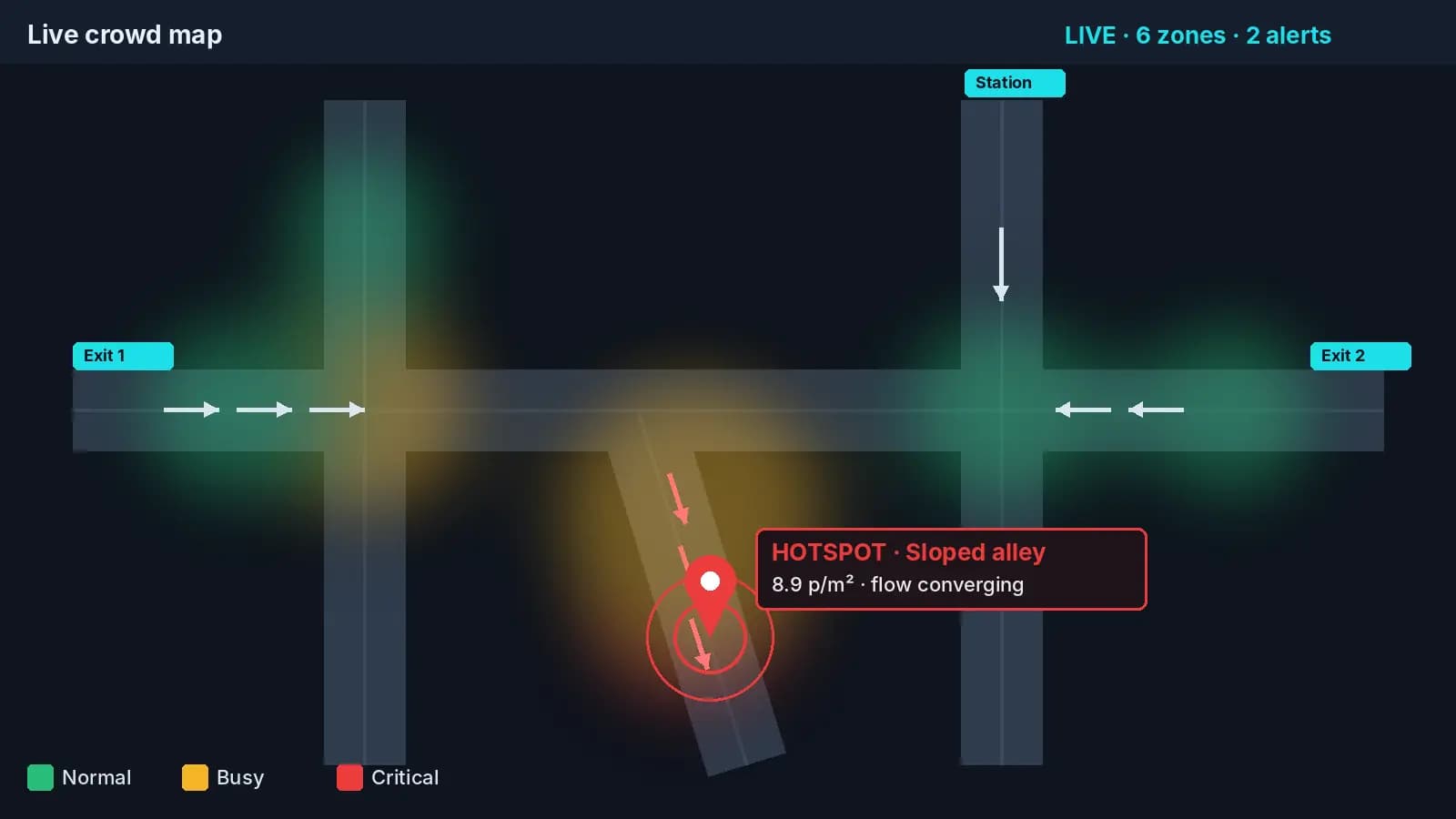
Live crowd map
A top-down map of the site shows the crowd as it is right now, with gates, exits and monitored zones marked. Nobody has to piece the picture together from a dozen separate camera angles.
Density heat map
Zones shift from blue to amber to red as they fill. On a chaotic night with music, noise and radio chatter, a patch of red is hard to miss.
Flow arrows and unusual-movement alerts
Arrows show which way people are heading. If a group starts pushing against the main flow, or the whole crowd begins to lean towards one point, the screen flags it.
Congestion hotspot pins
When density and pressure build at a bottleneck, a pin drops on that exact spot. It's the visual version of someone shouting "over there, now".
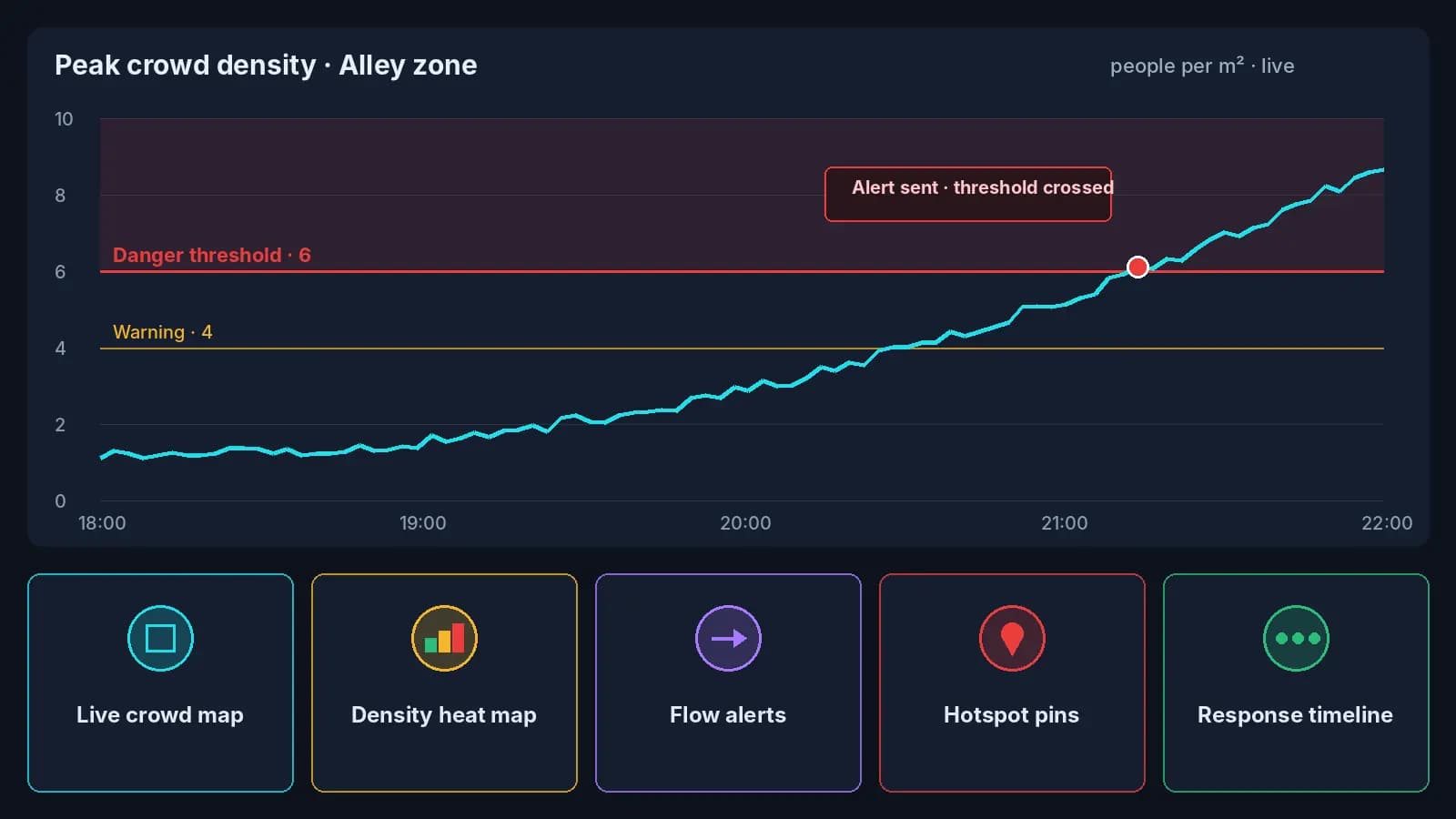
Density trend chart with a danger threshold
A live line tracks peak density against a clear danger mark. Teams can watch the line climb and step in well before it crosses.
Instant alerts and a response timeline
Alerts go straight to whoever can act, whether that's police, stewards, transit staff or medics. Each one is tracked from risk detected to authorities alerted to action taken, so a warning can't quietly fall between two teams.
Could AI Crowd Management Have Changed the Night in Itaewon?
Nobody can rewrite what happened, and no software replaces planning or accountability. Still, it's worth walking through that evening as if live crowd monitoring had been running.
Early evening: Station exits and street cameras show arrivals far above the year before. The dashboard marks Itaewon as high-risk hours before the peak.
Around 6:30 pm: The first calls about overcrowding match what the heat map already shows, with the lanes near World Food Street turning amber. There's time to set up one-way routes and hold people at the top of the slope.
Later in the night: The density line for the alley beside the Hamilton Hotel climbs towards the danger mark. A hotspot pin lands on the narrowest section rather than the district in general.
Before the crush: Trains could skip the station. Bars could be asked to cut the music so announcements carry. Officers could be sent into the one alley that mattered most.
People would still make every one of those calls. The difference is that they'd make them with a clear picture, early enough to matter.
Where AI Crowd Management Makes the Biggest Difference
The strongest case is wherever access is open and numbers are hard to predict: city celebrations, parades, Halloween and New Year's Eve. Religious gatherings and pilgrimages are another, because very large crowds move along fixed routes and through narrow gates. Stadiums and concerts benefit most at entry and exit, when everyone moves at once. Metro and rail hubs can overload a platform or stairway in minutes. Malls, airports and smart city command centres use the same tools to keep an eye on things around the clock.
A Quick Checklist for Safer Crowds
• Walk the site beforehand and mark every slope, stairway and pinch point, with a safe capacity for each.
• Treat events without an organiser as high-risk by default, and decide which agency is in charge.
• Watch density zone by zone in real time, not just total attendance.
• Agree in advance what density triggers a hold, a one-way system or a closure.
• Put transit operators, police and venue staff on the same live dashboard.
• Make sure 112 or 911 calls, camera alerts and field reports all reach one decision-maker.
• Go over the data afterwards and change the plan for next year.
Frequently Asked Questions
It's the use of computer vision and predictive analytics on CCTV, drone or sensor feeds to measure crowd density, follow movement and flag risks as they develop. Control rooms get early warnings and clear visuals, so they can act before a crowd becomes dangerous.
It picks up the conditions that come before a crush: rising density, people funnelling into a bottleneck, and sudden surges or counter-flows. Alerts arrive with an exact location, so teams can slow arrivals, open new routes or send help early.
On 29 October 2022, 159 people died in a crowd crush in a narrow, sloping alley in Seoul's Itaewon district during Halloween celebrations. Warnings about overcrowding had come in hours earlier, but crowd control and the emergency response fell short.
In most cases, yes. AI crowd management platforms, including CODEWORK's, are designed to work with camera networks that are already installed, adding analytics on top instead of replacing hardware.
It doesn't have to. Crowd analytics look at counts, density and movement, not identities. Systems can run without facial recognition and keep data only for a short, fixed period.
City authorities and police, event organisers, stadium and venue operators, transit agencies, temple and festival committees, airports, malls and smart city command centres.
Faster than most people expect. A busy area can tip into critical density in minutes rather than hours. In Itaewon, people at the top of the alley kept pushing for about 10 minutes after the first falls.
Every Second Matters
The people in that alley had gone out for a night of fun. Nearly every account since points to the same painful conclusion: the danger built up in plain sight, and the signs were there for anyone equipped to read them.
That's the problem CODEWORK's AI crowd management platform is built for. It brings live crowd maps, density heat maps, unusual-movement alerts, congestion hotspot pins and real-time trend charts together on one screen. The people responsible for a crowd can see trouble coming and act while there's still time.
Want to see these tools on your own camera feeds? Email sales@codework.ai or book a demo.
Related reading: AI Crowd Detection: How Technology Can Spot a Stampede Before It Starts
Sources
- • Malay Mail (Reuters): how a night of Halloween revelry turned to disaster (3 Nov 2022)
- • Al Jazeera: police investigation findings, crowd density and death toll (13 Jan 2023)
- • Malay Mail: former Yongsan police chief jailed (30 Sept 2024)
- • Asia News Network: former Seoul police chief acquitted (Oct 2024)